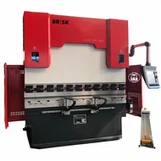
As a seasoned supplier of CNC press brake machines, I often encounter inquiries from customers regarding the capabilities of these advanced pieces of equipment. One of the most frequently asked questions is whether a CNC press brake machine can perform multiple bends in one operation. In this blog post, I will delve into this topic, exploring the technical aspects, advantages, and limitations of performing multiple bends in a single operation using a CNC press brake machine.


Understanding CNC Press Brake Machines
Before we discuss the possibility of multiple bends in one operation, let's first understand what a CNC press brake machine is. A CNC (Computer Numerical Control) press brake is a precision metalworking machine used to bend sheet metal and plates into various shapes. It consists of a punch and a die, which work together to apply force to the metal, causing it to bend at a specific angle. The CNC system allows for precise control of the bending process, including the angle, depth, and length of the bend.
CNC press brake machines offer several advantages over traditional manual press brakes, including higher accuracy, repeatability, and productivity. They can also be programmed to perform complex bending operations, making them ideal for a wide range of applications in industries such as automotive, aerospace, and manufacturing.
Can a CNC Press Brake Machine Perform Multiple Bends in One Operation?
The short answer is yes, a CNC press brake machine can perform multiple bends in one operation. This is made possible by the advanced programming capabilities of the CNC system, which allows for the precise control of the punch and die movements. By programming the machine to perform a series of bends in a specific sequence, it is possible to create complex shapes and geometries in a single setup.
There are two main methods for performing multiple bends in one operation using a CNC press brake machine: progressive bending and simultaneous bending.
Progressive Bending
Progressive bending involves performing a series of sequential bends on the metal sheet or plate. The CNC system moves the punch and die to the appropriate positions for each bend, and the machine applies the necessary force to create the bend. This process is repeated for each bend in the sequence until the desired shape is achieved.
Progressive bending is a common method for performing multiple bends in one operation, as it allows for precise control of the bending process and can be used to create complex shapes. However, it can be time-consuming, especially for parts with a large number of bends.
Simultaneous Bending
Simultaneous bending involves performing multiple bends at the same time using multiple punches and dies. The CNC system coordinates the movements of the punches and dies to ensure that all the bends are made simultaneously. This method is faster than progressive bending and can be used to create parts with a high degree of accuracy and repeatability.
Simultaneous bending is typically used for parts with simple geometries and a small number of bends. It requires specialized tooling and programming, which can increase the cost of the machine and the setup time.
Advantages of Performing Multiple Bends in One Operation
Performing multiple bends in one operation using a CNC press brake machine offers several advantages, including:
Increased Productivity
By performing multiple bends in a single setup, the CNC press brake machine can significantly reduce the time required to produce a part. This can increase productivity and reduce labor costs, making it an attractive option for high-volume production.
Improved Accuracy and Repeatability
The advanced programming capabilities of the CNC system allow for precise control of the bending process, ensuring that each bend is made to the exact specifications. This results in improved accuracy and repeatability, which is essential for producing high-quality parts.
Reduced Material Waste
Performing multiple bends in one operation can also reduce material waste by minimizing the number of cuts and scrap pieces. This can save on material costs and make the manufacturing process more environmentally friendly.
Enhanced Design Flexibility
The ability to perform multiple bends in one operation allows for the creation of complex shapes and geometries that would be difficult or impossible to achieve using traditional bending methods. This can enhance design flexibility and open up new possibilities for product development.
Limitations of Performing Multiple Bends in One Operation
While performing multiple bends in one operation using a CNC press brake machine offers many advantages, there are also some limitations to consider. These include:
Complexity of Programming
Performing multiple bends in one operation requires advanced programming skills and knowledge of the CNC system. This can make the setup process more time-consuming and may require additional training for operators.
Tooling Requirements
Simultaneous bending requires specialized tooling, which can be expensive and may need to be custom-designed for each part. This can increase the cost of the machine and the setup time.
Material Thickness and Type
The ability to perform multiple bends in one operation depends on the thickness and type of the material being bent. Thicker materials may require more force to bend, which can limit the number of bends that can be made in one operation. Certain materials, such as stainless steel and aluminum, may also require special tooling and techniques to achieve the desired results.
Part Size and Geometry
The size and geometry of the part being bent can also affect the ability to perform multiple bends in one operation. Larger parts may require a larger press brake machine, which can increase the cost and complexity of the setup. Complex geometries may also require more advanced programming and tooling, which can further increase the cost and setup time.
Conclusion
In conclusion, a CNC press brake machine can perform multiple bends in one operation, thanks to its advanced programming capabilities and precise control of the bending process. Performing multiple bends in one operation offers several advantages, including increased productivity, improved accuracy and repeatability, reduced material waste, and enhanced design flexibility. However, there are also some limitations to consider, such as the complexity of programming, tooling requirements, material thickness and type, and part size and geometry.
If you are interested in learning more about our Manual Press Brake Bending Machine, Heavy Duty Iron Sheet Bending Machine, or Small Electric Press Brake Machine, or if you have any questions about performing multiple bends in one operation using a CNC press brake machine, please feel free to contact us. Our team of experts is always available to provide you with the information and support you need to make the right decision for your business.
References
- "CNC Press Brake Machines: A Comprehensive Guide." Manufacturing.net.
- "Bending Technology: How to Perform Multiple Bends in One Operation." The Fabricator.
- "Advantages and Limitations of CNC Press Brake Machines." Metalworking News.