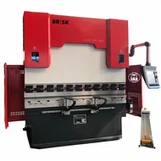
Hey there! I'm from a Sheet Metal Press Brake [hyperlink text="Sheet Metal Press Brake" url="/press-brake/cnc-press-brake/sheet-metal-press-brake.html"] supplier, and today I wanna talk about how to calculate the bending force required for a specific sheet in a press brake. It's a common question I get from customers, and it's super important to get it right for a successful bending operation.
First off, let's understand why calculating the bending force matters. If you use too little force, the sheet won't bend properly, and you'll end up with an inaccurate angle or a bend that doesn't look right. On the other hand, if you use too much force, you could damage the sheet, the press brake tooling, or even the machine itself. So, getting the right bending force is crucial for both the quality of the product and the longevity of your equipment.
There are a few factors that you need to consider when calculating the bending force. The main ones are the material type, the thickness of the sheet, the length of the bend, and the inside bend radius.
Material Type
Different materials have different mechanical properties, which means they require different amounts of force to bend. For example, stainless steel is generally harder to bend than mild steel. You can usually find the material's yield strength in a material properties table. The yield strength is the amount of stress a material can withstand before it starts to deform permanently. The higher the yield strength, the more force you'll need to bend the material.
Sheet Thickness
The thicker the sheet, the more force you'll need to bend it. This is pretty intuitive - a thicker piece of metal is stronger and more resistant to bending. The relationship between sheet thickness and bending force is not linear, though. As the thickness increases, the required bending force increases at a greater rate.
Bend Length
The length of the bend also affects the bending force. A longer bend requires more force because you're trying to deform a larger portion of the sheet. If you're bending a long, narrow strip of metal, you'll need more force than if you're bending a short piece of the same thickness and material.


Inside Bend Radius
The inside bend radius is the radius of the curve on the inside of the bend. A smaller inside bend radius requires more force because you're trying to make a sharper bend. If you want a tight bend, you'll need to apply more pressure to the sheet.
Now that we know the factors that affect the bending force, let's talk about how to calculate it. There are a few different formulas you can use, but one of the most common is the following:
[ F = \frac{650 \times S \times t^2 \times L}{V} ]
Where:
- ( F ) is the bending force in tons
- ( S ) is the material's yield strength in ( N/mm^2 )
- ( t ) is the sheet thickness in mm
- ( L ) is the length of the bend in mm
- ( V ) is the die opening in mm
Let's break this formula down a bit. The 650 is a constant that takes into account the mechanical properties of the press brake and the bending process. The ( S \times t^2 ) part represents the material's resistance to bending, based on its yield strength and thickness. The ( L ) represents the length of the bend, and the ( V ) represents the die opening. The die opening is the distance between the two halves of the die, and it affects how the sheet is bent.
Let's do an example to see how this formula works. Suppose you're bending a mild steel sheet that's 3 mm thick, 1000 mm long, with a yield strength of 240 ( N/mm^2 ). You're using a die opening of 20 mm. Plugging these values into the formula, we get:
[ F = \frac{650 \times 240 \times 3^2 \times 1000}{20} ]
[ F = \frac{650 \times 240 \times 9 \times 1000}{20} ]
[ F = \frac{1404000 \times 1000}{20} ]
[ F = 70200000 \div 1000 ]
[ F = 70.2 \text{ tons} ]
So, in this example, you'd need a press brake that can generate at least 70.2 tons of force to bend the sheet.
It's important to note that this formula is just an approximation. There are other factors that can affect the bending force, such as the type of press brake (mechanical, hydraulic, etc.), the condition of the tooling, and the friction between the sheet and the tooling. In real-world applications, you might need to adjust the calculated force based on your experience and the specific conditions of your bending operation.
Now, let's talk about some of the tools and equipment we offer at our company. We have a wide range of [hyperlink text="Sheet Metal Press Brake" url="/press-brake/cnc-press-brake/sheet-metal-press-brake.html"] machines to suit different needs and budgets.
If you're looking for a smaller, more affordable option, we have [hyperlink text="Small Electric Press Brake Machine" url="/press-brake/cnc-press-brake/small-press-brake.html"] that are perfect for light-duty bending tasks. These machines are easy to operate and take up less space in your workshop.
For heavy-duty applications, we offer [hyperlink text="Heavy Duty Iron Sheet Bending Machine" url="/press-brake/cnc-press-brake/sheet-metal-bending-machine.html"] that can handle thick sheets of metal and large bending forces. These machines are built to last and can provide consistent, high-quality results.
Calculating the bending force required for a specific sheet in a press brake is an important step in the sheet metal fabrication process. By understanding the factors that affect the bending force and using the right formula, you can ensure that you're using the correct amount of force for your bending operation. And if you're in the market for a press brake, we're here to help. We have the expertise and the equipment to meet your sheet metal bending needs.
If you have any questions about calculating bending force or about our [hyperlink text="Sheet Metal Press Brake" url="/press-brake/cnc-press-brake/sheet-metal-press-brake.html"] machines, feel free to reach out. We're always happy to help you find the right solution for your business. Whether you're a small workshop or a large manufacturing facility, we can provide you with the equipment and support you need to succeed. So, don't hesitate to contact us if you're interested in purchasing a press brake or if you need more information about our products.
References
- ASM Handbook Volume 2: Properties and Selection: Nonferrous Alloys and Special-Purpose Materials
- Machinery's Handbook, 31st Edition