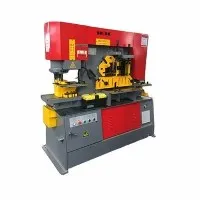
Hey there, folks! I'm a supplier of hydraulic guillotines, and today I wanna talk about one of the most common questions I get: What is the maximum cutting speed for different materials on a hydraulic guillotine? It's a crucial question, especially if you're in the metal - working or manufacturing industry, as the cutting speed can significantly impact your productivity and the quality of your work.
Let's start with the basics. A hydraulic guillotine is a powerful tool used to cut various materials, mainly metals. It uses hydraulic power to drive the cutting blade, providing a clean and precise cut. There are different types of hydraulic guillotines available on the market, such as the Industrial CNC Hydraulic Shearing Machine, which offers high precision with computer - numerical control, and the Metal Punching and Shearing Machine that combines punching and shearing functions.
Cutting Speed for Mild Steel
Mild steel is one of the most commonly cut materials using a hydraulic guillotine. It's relatively easy to work with and has good ductility. The maximum cutting speed for mild steel depends on several factors, including the thickness of the material.
For thin mild steel sheets (less than 3mm), the cutting speed can be quite high. You can expect a hydraulic guillotine to cut at speeds of up to 60 - 80 strokes per minute. This high speed is possible because the blade doesn't have to work as hard to cut through the thin material. As the thickness of the mild steel increases, say from 3mm to 6mm, the cutting speed will decrease. In this range, a typical maximum cutting speed might be around 30 - 50 strokes per minute.
Once you're dealing with thick mild steel (over 6mm), the cutting speed will drop even further. For example, for a 10mm thick mild steel sheet, you might only be able to achieve a maximum cutting speed of 15 - 25 strokes per minute. The reason for this decrease in speed is that the blade needs more force to cut through the thicker material, and the hydraulic system needs more time to build up that force.
Cutting Speed for Stainless Steel
Stainless steel is a bit more challenging to cut than mild steel. It's harder and has a higher strength, which means the blade has to work harder to make a cut.
For thin stainless steel sheets (less than 2mm), the maximum cutting speed can reach about 40 - 60 strokes per minute. But as the thickness increases, the cutting speed drops rapidly. For 3 - 5mm thick stainless steel, the maximum speed might be around 15 - 30 strokes per minute. When you're cutting stainless steel that's over 5mm thick, the cutting speed can be as low as 5 - 15 strokes per minute.
The high - strength nature of stainless steel also means that the blade will wear out faster compared to when cutting mild steel. So, you need to be more careful about blade maintenance and replacement when working with stainless steel.
Cutting Speed for Aluminum
Aluminum is a lightweight and soft metal, which makes it relatively easy to cut with a hydraulic guillotine. For thin aluminum sheets (less than 5mm), the cutting speed can be quite impressive. You can achieve speeds of up to 80 - 100 strokes per minute.
As the thickness of the aluminum increases, say from 5mm to 10mm, the cutting speed will still be relatively high, around 40 - 60 strokes per minute. For thicker aluminum sheets (over 10mm), the cutting speed will decrease to about 20 - 40 strokes per minute. The softness of aluminum also means that there's less wear on the blade, which is a plus for long - term use.
Cutting Speed for Copper
Copper is another soft metal, but it has different properties compared to aluminum. For thin copper sheets (less than 3mm), the maximum cutting speed can be around 70 - 90 strokes per minute. When the thickness of the copper increases to 3 - 6mm, the cutting speed will be around 30 - 50 strokes per minute. For copper sheets over 6mm thick, the cutting speed will drop to about 15 - 30 strokes per minute.
Factors Affecting Cutting Speed
It's important to note that these are just general guidelines, and the actual cutting speed can be affected by several factors.
- Blade Sharpness: A sharp blade will cut through materials more easily and at a higher speed. Dull blades not only slow down the cutting process but also produce poor - quality cuts.
- Hydraulic System Performance: The power and efficiency of the hydraulic system play a big role. A well - maintained and high - performance hydraulic system can provide the necessary force quickly, allowing for faster cutting speeds.
- Machine Design and Rigidity: A more rigid machine design can handle higher cutting forces without vibration, which is essential for maintaining a high cutting speed and a good - quality cut.
- Cutting Angle: The angle of the cutting blade can also affect the cutting speed. A proper cutting angle can reduce the force required to cut through the material, enabling faster cuts.
Our Hydraulic Guillotines
At our company, we offer a wide range of Hydraulic Metal Guillotine Cutter that are designed to provide optimal cutting speeds for different materials. Our machines are built with high - quality components and advanced hydraulic systems to ensure reliable and efficient performance.
We understand that every customer has different needs, whether you're cutting thin sheets at high speeds or thick materials that require more force. That's why we offer customizable options for our hydraulic guillotines, so you can get a machine that's tailored to your specific requirements.


Contact Us for Purchase
If you're in the market for a hydraulic guillotine and want to know more about the cutting speeds for your specific material and thickness requirements, don't hesitate to reach out. We're here to answer all your questions and help you find the right machine for your business.
Whether you're a small - scale workshop or a large - scale manufacturing plant, we have the right solution for you. Contact us today to start the conversation about how our hydraulic guillotines can improve your cutting operations and boost your productivity.
References
- "Metal Cutting Handbook", Industrial Press Inc.
- "Machining Processes and Machine Tools", Pearson Education