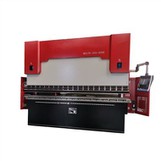
In the manufacturing industry, the NC Press Brake is a crucial piece of equipment used for bending metal sheets and plates. As a supplier of NC Press Brakes, I've witnessed firsthand the significance of various factors in the bending process, and one of the most critical aspects is the bending speed. This blog post aims to explore the impact of bending speed on the quality of the bent parts produced by an NC Press Brake.
Understanding the Basics of NC Press Brakes
Before delving into the impact of bending speed, it's essential to understand how an NC Press Brake operates. An NC Press Brake, or Numerical Control Press Brake, is a machine that uses hydraulic or mechanical force to bend metal sheets and plates into various shapes. The machine is controlled by a computer numerical control (CNC) system, which allows for precise control of the bending process. The bending process involves applying a force to the metal sheet or plate between a punch and a die, causing it to deform and take on the desired shape.
The Role of Bending Speed
Bending speed refers to the rate at which the punch moves downwards to bend the metal sheet or plate. It is typically measured in millimeters per second (mm/s). The bending speed can have a significant impact on the quality of the bent parts, including the accuracy of the bend angle, the surface finish of the bent part, and the overall strength and durability of the part.
Impact on Bend Angle Accuracy
One of the primary factors affected by bending speed is the accuracy of the bend angle. When the bending speed is too high, the metal may not have enough time to deform properly, resulting in a bend angle that is larger or smaller than the desired angle. This is because the metal has a certain amount of elasticity, and if it is bent too quickly, it may spring back to its original shape after the bending force is removed. On the other hand, if the bending speed is too low, the metal may deform unevenly, leading to variations in the bend angle along the length of the part.
To achieve the most accurate bend angle, it is important to find the optimal bending speed for the specific material and thickness of the metal being bent. This may require some experimentation and adjustment, but most modern NC Press Brakes are equipped with advanced control systems that can automatically adjust the bending speed based on the material properties and the desired bend angle.
Impact on Surface Finish
The bending speed can also have a significant impact on the surface finish of the bent part. When the bending speed is too high, the metal may experience excessive friction and heat generation, which can cause the surface of the part to become rough or even develop cracks. This is particularly true for materials that are prone to work hardening, such as stainless steel and aluminum. On the other hand, if the bending speed is too low, the metal may not be bent smoothly, resulting in a surface finish that is uneven or has visible marks.
To achieve a smooth and consistent surface finish, it is important to use the appropriate bending speed and to ensure that the punch and die are properly lubricated. Lubrication helps to reduce friction and heat generation, which can improve the surface finish of the bent part and extend the life of the punch and die.
Impact on Strength and Durability
The bending speed can also affect the strength and durability of the bent part. When the bending speed is too high, the metal may experience excessive stress and strain, which can cause it to become brittle and prone to cracking. This is particularly true for materials that are already prone to cracking, such as high-strength steels and some types of aluminum alloys. On the other hand, if the bending speed is too low, the metal may not be bent enough, resulting in a part that is weaker and less durable than it should be.
To ensure that the bent part has the required strength and durability, it is important to use the appropriate bending speed and to follow the recommended bending procedures for the specific material being bent. This may include preheating the material, using the correct punch and die geometry, and ensuring that the part is properly supported during the bending process.
Finding the Optimal Bending Speed
Finding the optimal bending speed for a specific application requires a combination of experience, knowledge, and experimentation. As a supplier of NC Press Brakes, we offer our customers comprehensive training and support to help them find the optimal bending speed for their specific needs. Our advanced control systems also allow for precise control of the bending speed, making it easier to achieve consistent and accurate results.


In general, the optimal bending speed will depend on several factors, including the material properties, the thickness of the metal, the desired bend angle, and the type of punch and die being used. For example, softer materials such as aluminum and copper can typically be bent at higher speeds than harder materials such as steel and titanium. Thicker materials also generally require slower bending speeds than thinner materials.
Conclusion
In conclusion, the bending speed has a significant impact on the quality of the bent parts produced by an NC Press Brake. By understanding the relationship between bending speed and bend angle accuracy, surface finish, and strength and durability, manufacturers can optimize their bending processes to achieve the best possible results. As a supplier of Hydraulic Sheet Metal Press Brake, Hydraulic Press Bending Machine, and Hydraulic Press Brake Machine, we are committed to providing our customers with the highest quality equipment and support to help them achieve their manufacturing goals.
If you are interested in learning more about our NC Press Brakes or have any questions about the bending process, please do not hesitate to contact us. We would be happy to discuss your specific needs and provide you with a customized solution.
References
- Smith, J. (2018). Metal Forming Processes and Die Design. CRC Press.
- Davis, J. R. (2008). Aluminum and Aluminum Alloys. ASM International.
- Kalpakjian, S., & Schmid, S. R. (2014). Manufacturing Engineering and Technology. Pearson.