Hey there! As a supplier of Plate Bending Machines, I often get asked about how to calculate the required bending force for these machines. It's a crucial aspect because getting the bending force right ensures that you can bend plates accurately and efficiently without damaging the machine or the workpiece. So, let's dive into it!
Understanding the Basics of Plate Bending
Before we start calculating the bending force, it's important to understand a bit about how plate bending works. When you're using a plate bending machine, you're essentially applying a force to a flat plate to deform it into a curved shape. The amount of force you need depends on several factors, such as the thickness of the plate, the length of the bend, the material of the plate, and the desired radius of the bend.
Factors Affecting Bending Force
- Plate Thickness: Thicker plates require more force to bend. It's pretty intuitive - the more material you have to deform, the more energy you need. For example, bending a 10 - mm thick plate will need a lot more force than bending a 3 - mm thick plate.
- Plate Length: The longer the length of the plate that you're bending, the higher the bending force required. This is because you're essentially trying to deform a larger area of the plate.
- Material Properties: Different materials have different mechanical properties. For instance, steel is generally stronger and more difficult to bend compared to aluminum. The yield strength of the material plays a big role here. Yield strength is the point at which the material starts to deform permanently. Materials with higher yield strengths will need more force to bend.
- Bend Radius: A smaller bend radius means that you're deforming the plate more sharply, which requires more force. If you want a tight curve, you'll have to apply a greater bending force compared to a more gentle curve.
Calculating the Bending Force
There are a few formulas that you can use to calculate the bending force. One of the most commonly used formulas is the following:
[F=\frac{650 \times S^2 \times L}{V}]
Where:
- (F) is the bending force in kilonewtons (kN).
- (S) is the thickness of the plate in millimeters (mm).
- (L) is the length of the bend in millimeters (mm).
- (V) is the die opening in millimeters (mm). The die opening is the distance between the two lower rolls or the bottom and the top of the die in the bending machine.
Let's take an example to make this clearer. Suppose you have a steel plate that is 5 mm thick and you want to bend a length of 2000 mm. The die opening is set at 40 mm. Using the formula:
[F=\frac{650\times5^2\times2000}{40}]
[F=\frac{650\times25\times2000}{40}]
[F = \frac{32500000}{40}=81250\ N = 81.25\ kN]
However, this formula is a simplified version and has some limitations. It assumes that the material is homogeneous and isotropic, and it doesn't take into account the specific properties of the bending machine.


Another more accurate formula that takes into account the material's yield strength ((R_y)) is:
[F=\frac{0.6 \times R_y\times S^2\times L}{V}]
Where (R_y) is the yield strength of the material in megapascals (MPa). For example, if the yield strength of the steel is 300 MPa, using the same plate thickness ((S = 5) mm), length ((L=2000) mm), and die opening ((V = 40) mm):
[F=\frac{0.6\times300\times5^2\times2000}{40}]
[F=\frac{0.6\times300\times25\times2000}{40}]
[F=\frac{9000000}{40}=225000\ N = 225\ kN]
Using Our Plate Bending Machines
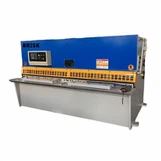
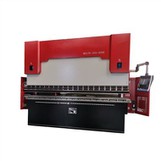
At our company, we offer a range of high - quality plate bending machines, including the Four - roller Plate Bending Machine and the 4 Roller Plate Bending Machine. These machines are designed to provide accurate and efficient bending operations.
Our four - roller plate bending machines are especially great for handling large - scale bending tasks. They have advanced control systems that allow you to adjust the bending force and other parameters easily. The four - roller design provides better control over the bending process, resulting in more precise bends.
Importance of Accurate Bending Force Calculation
Getting the bending force calculation right is not just about getting the job done. It also has several other benefits.
- Machine Safety: If you apply too much force, you can damage the bending machine. This can lead to costly repairs and downtime. On the other hand, if you apply too little force, you won't be able to bend the plate properly.
- Workpiece Quality: An accurate bending force ensures that the plate is bent to the desired shape and dimensions. This is crucial, especially in industries where precision is key, such as aerospace and automotive manufacturing.
- Cost - Efficiency: By calculating the bending force accurately, you can optimize the use of energy and materials. You won't waste energy by applying excessive force, and you'll get the best results with the least amount of material waste.
Conclusion
Calculating the required bending force for a plate bending machine is a complex but essential task. It involves considering multiple factors such as plate thickness, length, material properties, and bend radius. Using the right formulas can help you get a good estimate of the bending force.
If you're in the market for a high - quality plate bending machine or need more information about bending force calculations, don't hesitate to reach out. We're here to help you with all your plate bending needs. Whether you're a small - scale workshop or a large - scale manufacturing plant, we have the right machine for you. Contact us today to start a discussion about your requirements and how we can assist you in achieving the best bending results.
References
- "Metal Forming Handbook: Processes and Applications" by G. E. Dieter
- "Manufacturing Engineering and Technology" by S. Kalpakjian and S. R. Schmid