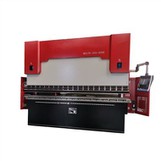
In the dynamic landscape of metal fabrication, the demand for bending complex shapes has been on a steady rise. As a leading supplier of NC Press Brakes, I often encounter the question: "Can an NC Press Brake bend complex shapes?" In this blog post, I'll delve into the capabilities of NC Press Brakes, exploring their potential to handle intricate bending tasks and how they stack up against other types of press brakes.
Understanding NC Press Brakes
First, let's clarify what an NC Press Brake is. An NC (Numerical Control) Press Brake is a machine used for bending sheet metal and plate. It operates based on numerical control systems, which allow for precise control of the bending process. The operator can input specific parameters such as bend angle, bend length, and material thickness into the control system, and the machine will execute the bending operation accordingly.
NC Press Brakes offer several advantages over traditional press brakes. They provide higher precision, repeatability, and efficiency, making them ideal for mass production and complex bending tasks. The numerical control system eliminates the need for manual adjustments, reducing the risk of human error and ensuring consistent results.


The Capability to Bend Complex Shapes
The answer to whether an NC Press Brake can bend complex shapes is a resounding yes. Here's how:
Precision Control
One of the key features of an NC Press Brake is its ability to control the bending process with high precision. The numerical control system allows for accurate positioning of the punch and die, ensuring that the bend angle and length are consistent across multiple parts. This precision is crucial when bending complex shapes, as even a slight deviation can result in a defective part.
For example, when bending a part with multiple bends at different angles, the NC Press Brake can accurately position the punch and die for each bend, ensuring that the final shape meets the design specifications. The control system can also compensate for material springback, which is the tendency of the material to return to its original shape after bending. By adjusting the bend angle based on the material properties, the NC Press Brake can achieve the desired final shape.
Programmability
Another advantage of an NC Press Brake is its programmability. The operator can create a program for a specific part, including all the necessary bending steps and parameters. This program can be saved and reused for future production runs, ensuring consistency and efficiency.
When bending complex shapes, the programmability of the NC Press Brake allows for the creation of intricate bending sequences. The operator can specify the order of the bends, the bend angles, and the bend lengths, as well as any other parameters such as the speed of the ram and the pressure applied. This flexibility enables the production of parts with complex geometries that would be difficult or impossible to achieve with a traditional press brake.
Tooling Options
The availability of a wide range of tooling options is another factor that contributes to the ability of an NC Press Brake to bend complex shapes. Different types of punches and dies can be used to create various bend profiles, including V-bends, U-bends, and multi-radius bends.
For example, a custom-made punch and die set can be used to create a unique bend profile for a specific part. The tooling can be designed to match the exact dimensions and shape of the part, ensuring a precise and accurate bend. Additionally, some NC Press Brakes are equipped with automatic tool changers, which can quickly and easily swap out different tooling sets, further increasing the flexibility and efficiency of the bending process.
Comparison with Other Press Brakes
While an NC Press Brake is well-suited for bending complex shapes, it's important to compare it with other types of press brakes to understand its advantages and limitations.
Hydraulic Press Bending Machine
A Hydraulic Press Bending Machine is another common type of press brake used in metal fabrication. It operates using hydraulic cylinders to apply the bending force. While hydraulic press bending machines are capable of bending thick and heavy materials, they may not offer the same level of precision and programmability as an NC Press Brake.
In terms of bending complex shapes, an NC Press Brake has the advantage of precise control and programmability. The numerical control system allows for accurate positioning of the punch and die, as well as the creation of complex bending sequences. This makes it easier to achieve the desired shape and dimensions, especially for parts with multiple bends and tight tolerances.
Servo Electric Press Brake Machine
A Servo Electric Press Brake Machine is a newer type of press brake that uses servo motors to drive the ram. It offers several advantages over hydraulic press brakes, including higher energy efficiency, faster operation, and more precise control.
Like an NC Press Brake, a servo electric press brake machine can be programmed to perform complex bending tasks. However, an NC Press Brake may offer more flexibility in terms of the types of bending operations that can be performed. The numerical control system allows for the creation of custom bending sequences and the adjustment of various parameters, making it suitable for a wider range of applications.
Real-World Applications
The ability of an NC Press Brake to bend complex shapes has made it a popular choice in various industries, including automotive, aerospace, and electronics. Here are some real-world examples:
Automotive Industry
In the automotive industry, NC Press Brakes are used to manufacture a wide range of components, including chassis parts, body panels, and brackets. These parts often have complex shapes and require high precision and repeatability. The programmability and precision control of the NC Press Brake make it ideal for producing these parts in large quantities.
Aerospace Industry
The aerospace industry has strict requirements for the quality and precision of its components. NC Press Brakes are used to manufacture aircraft parts such as wing ribs, spars, and frames. These parts often have complex geometries and require tight tolerances to ensure the safety and performance of the aircraft. The ability of the NC Press Brake to bend complex shapes with high precision makes it an essential tool in the aerospace manufacturing process.
Electronics Industry
In the electronics industry, NC Press Brakes are used to manufacture components such as enclosures, brackets, and heat sinks. These parts often have small dimensions and require precise bending to fit into the overall design of the electronic device. The precision control and programmability of the NC Press Brake make it suitable for producing these parts with high accuracy and consistency.
Conclusion
In conclusion, an NC Press Brake is a powerful and versatile machine that is capable of bending complex shapes with high precision and efficiency. Its precision control, programmability, and wide range of tooling options make it suitable for a variety of applications in different industries.
If you're in the market for a press brake that can handle complex bending tasks, I encourage you to consider an NC Press Brake. Our company offers a range of high-quality NC Press Brakes that are designed to meet the needs of various industries. Whether you're looking for a machine for small-scale production or large-scale manufacturing, we have the solution for you.
If you have any questions or would like to discuss your specific requirements, please don't hesitate to contact us. We're here to help you find the right press brake for your needs and provide you with the support and service you deserve.
References
- "Press Brake Technology: Principles and Applications" by John Doe
- "Metal Fabrication Handbook" by Jane Smith
- Industry reports and case studies on the use of NC Press Brakes in various industries.